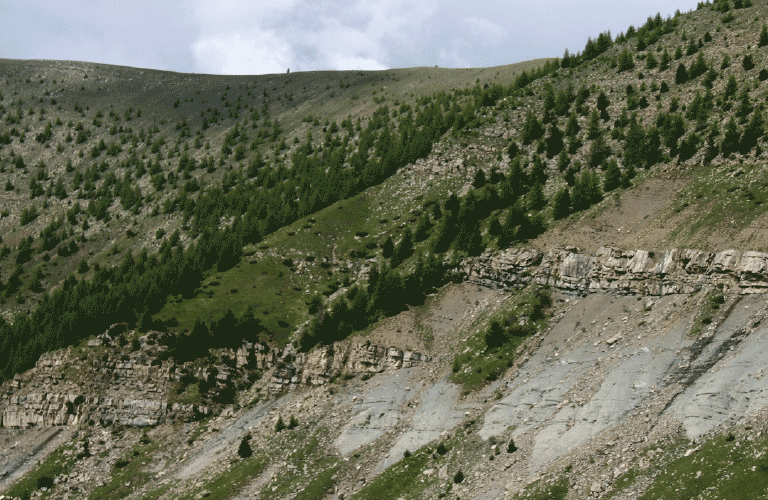
Basin-Scale Analysis of Confined Turbidite Systems (Annot, SE France)
Experience the classic, well exposed Grès d’Annot turbidite outcrop area in the French Alps; a good analogue for deepwater exploration and development targets in structurally active slope and basin settings.
Geologists and geophysicists evaluating exploration provinces or fields in deepwater confined basins, within deepwater fold and thrust belts, rift and early post-rift settings and salt areas. Experienced reservoir engineers will gain a deeper knowledge of the geological parameter ranges that underpin simulation models.
Duration
6 days, One day travel in UK-Nice, one day return.
Learning Level
Skills
Knowledge
Awareness
Geoscientists spend time examining confined deepwater basins in the subsurface using a combination of seismic, well, core and production data.
This course aims to provide insights into the analysis of these basins by using outcrop exposures of an analogous suite of sub-basins. Observing and discussing ranges from large (seismic) scale to small (core) scale.
The structural setting informs on a full range of scales, including regional balanced and restored cross sections, sub-basin scale patterns of onlap and facies changes, observations at outcrop scale, down to core-scale detail. You will be taught the range of observations required to make predictive subsurface models for reservoir and seal in structurally active basin settings; the lessons learned are applicable in all tectonic settings (compressional, extensional salt, mobile shale).
Detailed observations are undertaken in a sub-basin scale context that is analogous to basins with complex topographies such as deepwater fold and thrust belts, rift and early post-rift settings and salt provinces.
Course Content
The Grès d’Annot includes a range of bed-scale deposits such as low and high concentration turbidites, debris flows as well as slumps and slides. Deepwater elements examined and thin & thick bedded turbidite lobes, turbidite channels, seismic scale mass transport deposits and onlap margin sediment bodies. Examine facies and architecture differences and distribution between individual sub-basins, predict the factors controlling these differences. Leading to an improved understanding between partially confined and ponded basins and the effects of confinement on bed-scale deposits, architecture stacking patterns and stratigraphic basin-fill sequences. On the course you will:
Assess discrete, structurally controlled sediment transport pathways into bathymetrically complex deepwater basins.
Understand the role of basin initiation and closure as external controls on basin fill and remobilisation sequences.
Assess role of relative structural and flow confinement on turbidite reservoir & seal facies, reservoir stacking patterns, and stratigraphic architectures. Characterise different reservoir architectures in a series of mini-basins from proximal, shallow marine, through base of slope to mid and distal basin settings.
Through field observations and lectures, discuss, validate and link established models for structurally confined basins. For example, variations on spill & fill models; the impact evolving equilibrium profiles on turbidite lobes and channels; and internal vs. external controls on accommodation space. Consider the subsurface implications of the different models for linkage between mini-basins.
Examine multiple different basin margin onlaps in the field. Characterise and classify each example using published terminology. Apply these observations and integrate with other course objectives to express stratigraphic trap definition and seal integrity risks.
Characterise the range of bed-scale deposits from low density to high-density turbidites, linked turbidite-debrite deposits, and multiple scales of sediment remobilisation.
Access
Partly road-side, some local near-town walks, some strenuous walking.
Stan is a course tutor in the Reservoir and Open Air Series. He has a career background atHeriot Watt University, Maersk, Murphy Oil He is a deep-water clastic (turbidite) sedimentologist
Gill Apps
PhD
40+ years – geoscience
Gill is a course tutor in the Reservoir and Open Air Series. He has a career background as aResearch Fellow, University of Texas at Austin (current); BP, BHP and Shell. She is an expert in deep-water clastics in tectonically active and salt withdrawal basins; mentor and coach; STEM outreach
Mark Bentley
PhD 30+ years - geoscience
Mark develops and runs courses in the Open Air, Reservoir, E&P, Uncertainty & Risk and Energy Transition series for TRACS. He has a career background at Shell, AGR, TRACS and Langdale Geoscience. He has served as a distinguished lecturer for SPE and EAGE, acted as Training Director for TRACS and is an Associate Professor Heriot-Watt University. He is also co-author of the textbook ‘Reservoir Model Design’.


 Energy transition and renewables
 Early development
 E&P overview
 Reservoir
 Wells
Wells Business
 Open air
 Uncertainty and Risk
 e-Products