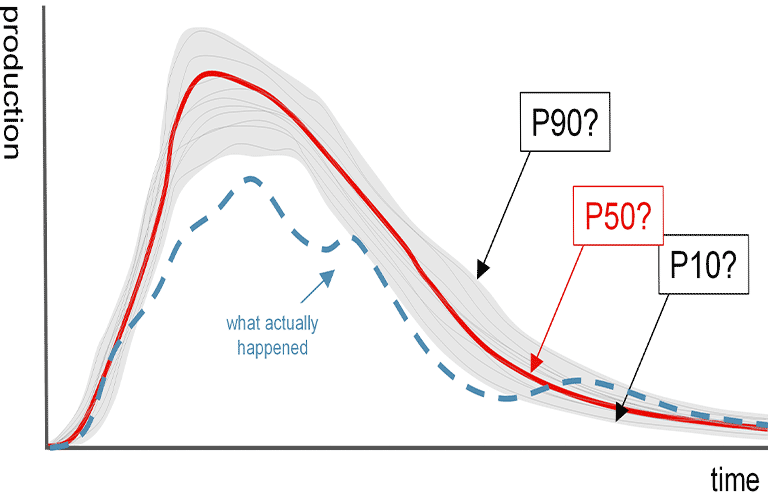
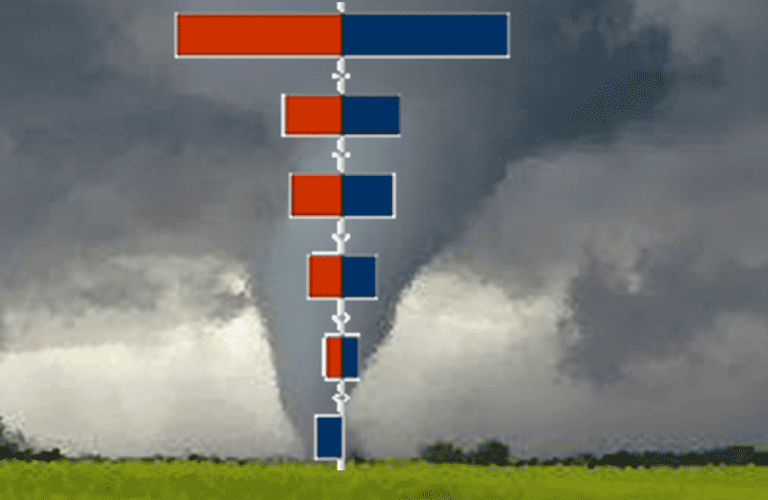
The quantification of uncertainty and risk is often discussed in the context of exploration and appraisal, yet most of the upstream E&P business concerns decision-making in producing assets.
Anyone involved in the quantification of uncertainty and risk in fields under development or in production, particularly mature fields. Geoscience, reservoir engineering, petrophysics, well technology, team leaders and management.
Duration
1 day
Learning Level
Skills
Knowledge
Awareness
Uncertainty-handling in development and production differs from that in E&A, as it must deal with a growing and often imperfect production database against a backdrop of constantly changing circumstances. As the life cycle progresses, initial uncertainties over volume and productivity narrow but are supplanted by new uncertainties such as sweep efficiency, fine scale architecture and changing responses to new production mechanisms and techniques. These new issues demand a change in approach for the quantification of uncertainty and vigilance is required to avoid the subsurface interpretation simply collapsing on to a best guess.
This Master Class explores the key aspects required to manage subsurface uncertainties and associated risks during the producing field life, in terms of:
People – identifying and avoiding common biases and heuristics which lead to poor decisions
Tools – making the best choice for given situations, balancing determinism and probability
Approach – practical methodologies which avoid getting bogged down in unnecessary detail
The course will close with a set of questions to ask yourself and others, suitable for reference in informal personal or team reviews, peer reviews and peer assists.
Course Content
Context
The driving issue: decision-making in producing assets
The key difference between uncertainty and risk in E&A vs. Development & Production
Why it matters – some examples
Practice
People – recognising personality and imperatives, sources of bias, common heuristicsand how to minimise them
Tools – the choice available, balancing simplicity and complexity, determinism and probability and the pros and cons of each
Team approach – stitching tools of choice into a coherent methodology, the primacy of the underlying concept, the choice between forward modelling and inversion and the key to successful team-based approaches beyond initial framing sessions: the Forth Rail Bridge
Advice
Questions to yourselves and others
Course Duration
1 day
Course Tutors
Richard Oxlade
MEng, CEng, BSc 40+ years - reservoir engineering and commercial
Richard runs courses in Reservoir and Business & Risk series. He has a career background at BP, AGR and TRACS. Richard is a global advisor, business planning & economic analysis.
Mark Bentley
PhD 30+ years - geoscience
Mark develops and runs courses in the Open Air, Reservoir, E&P, Uncertainty & Risk and Energy Transition series for TRACS. He has a career background at Shell, AGR, TRACS and Langdale Geoscience. He has served as a distinguished lecturer for SPE and EAGE, acted as Training Director for TRACS and is an Associate Professor Heriot-Watt University. He is also co-author of the textbook ‘Reservoir Model Design’.
Mark Cook
BSc, MBA 40+ years - reservoir engineering, economics and risk analysis
Mark develops and runs courses in Early Development, Business & Risk and Reservoir Engineering series. He has a career background at Shell, TRACS (Director), and AGR (VP). Mark is Author of ‘Petroleum Economics and Risk Analysis’ and co-author of ‘Hydrocarbon Exploration and Production’, an SPE distinguished lecturer, and guest lecturer at Heriot-Watt University.


 Energy transition and renewables
 Early development
 E&P overview
 Reservoir
 Wells
Wells Business
 Open air
 Uncertainty and Risk
 e-Products